 Unless you’ve been living under a rock, you probably know by now that Baltimore Rising is hell bent on initiating an all-inclusive economic recovery in the city. We’re talking about a turnaround of such nature and magnitude that it dramatically reduces unemployment and poverty.
Missing the Point
 A few minutes ago, we got around to reading the following tweet from the Mayor, shown below.
Very impressive? Not really.
Presidential Primary Turnout
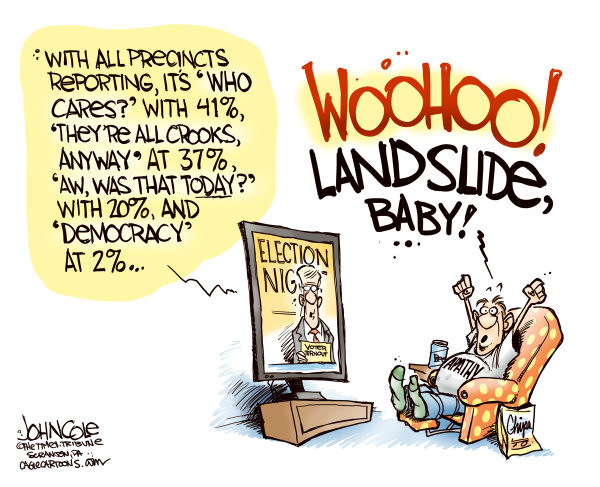 As may have read in our post, “Minority rule?“, the turnout at the last Mayoral Democratic primary, which was in 2011, was only 25%.
“That’s pathetic.”
Because.
 Hey. As you’ve probably noticed, there is a large, red “Contribute” button in the right column and a “Donate Now” button on our Facebook page (www.Facebook.com/Jobs4Baltimore). These buttons are there to help us raise the money we need to do the things we do.
Public Education, The 9 Year Solution
 In order to rebuild the Baltimore economy, we need to repopulate the city. To do that, we need to give people and businesses a safer environment, obviously, but also a superior public school system that young families with children can respect, that’s competitive with what the suburbs have to offer. That’s why Baltimore Rising is interested in effecting a dramatic, relatively short-term improvement in the quality of public education everywhere in the city. Everywhere. This isn’t about opening a special charter school here and there.
How do we reduce the property tax rate?
 Cutting property taxes is something we really, really need to do. Our rate, which is 2.248%, is almost twice that of the next highest county rate in the state. The rate in Charles County is 1.205%. If you were thinking maybe it was Howard County, the rate there is only 1.014%. Howard County doesn’t need a high property tax rate because its median household income is over $100,000, housing is much more expensive and the county isn’t spending $750 million a year on public safety.
Baseline
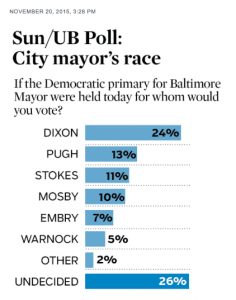 Yesterday, The Sun published the results of a poll it ran asking the usual question, the one that begins with, “If the election were held today…”
At best, these are baseline results, meaning that they are before any of the candidates is really campaigning, certainly not full-on they way they’ll be running around beginning in January and increasingly so the closer we get to April.
Priorities
 Is spending $4 million for a new water taxi terminal really the best use of those funds in a city where 25% of the people live in poverty?
Big TIF or Lots of Little TIFs?
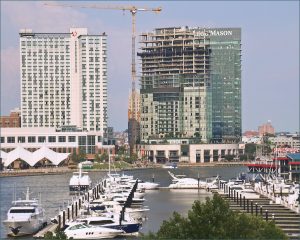 This is the second in our series of posts about TIFs. A TIF – if you remember from our piece entitled “To TIF or Not To TIF?” which became an instant classic – stands for Tax Increment Financing.
The Price of Public Safety
 Don’t you just love pie charts? Actually, it’s the pie part that I like most. Cherry pie, the kind with crisscrossed strips of crust. Chocolate pecan pie. …Unfortunately, holiday season or not, that’s not the kind of pie we’re talking about, is it?
$2500 annual tax credit to move into the city?
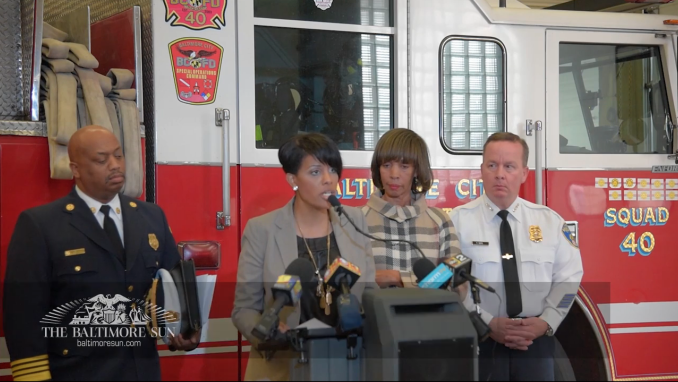 If you’ve read this morning’s Sun, you’ve seen the article entitled, “Mayor offers plan to provide $2,500 annual tax credit to city police, firefighters, sheriff’s deputies.”
The Economics of Dilution vs. Concentration
 It is the mission of Baltimore Rising to start a fire. We talk about it all the time. Not the destructive kind. No. Of course not. What we’re talking about is igniting all-inclusive economic growth that will, sooner rather than later, clean up the mess that Baltimore has become over the past 60 years. Those are the 60 years during which the manufacturing sector of the city collapsed and, for one reason or another, one third of our population, mostly from the top down, disappeared. A good many of them abandoned the city for the safer, more prosperous, better educated suburbs.