 Understandably, Sheila Dixon is the early favorite to win April’s Democratic primary and become the next Mayor of Baltimore. Baltimore Rising doesn’t like that outcome because we feel that Ms. Dixon is a poor choice for a city in desperate need of economic recovery. There’s nothing about her record in office or about her campaign to suggest that she appreciates that jobs creation – as part of all-inclusive economic growth, particularly in the city’s disadvantaged neighborhoods – must be the highest priority of city government. She doesn’t get it and wouldn’t know what to do about it even if she did.
Tag Archives: Baltimore
Cars-For-Jobs
 Jobs and the cars you need to get to them.
If you live in the city of Baltimore, you may have noticed that getting to work can be a very time-consuming, somewhat uncertain process. Commuting by bus can take a while, particularly if you have change lines, and reliability can also be problem. The Governor says he has a plan to make your life better. We’ll see how that works out.
No Reason To Wait
 No guarantees, of course, but we can help qualified employers get $100,000 to $10 million for construction and operations in selected Baltimore Neighborhoods.
Unemployment. How bad is it?
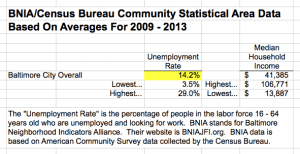 If you’re familiar with our work, you’ve heard us say or write the sentence, “Baltimore is a city in crisis.” We’re not kidding. We’re not just saying it for dramatic effect. It’s a fact. And why do we keep saying it? Because we’re concerned that our current city government and many candidates running for Mayor or Council don’t have an appropriate sense of urgency.
Urban Blight?
 In Sandtown yesterday, Governor Hogan with Mayor Rawlings-Blake announced an impressive $700 million program called CORE. The acronym stands for Creating Opportunities for Renewal and Enterprise. The link will take you to the official press release.
The idea is that a good number of selected vacant and abandoned structures in the city’s disadvantaged neighborhoods will be torn down over the next 4 years and turned into green spaces that will be developed, eventually, into to mixed use commercial and residential facilities.
Reality Check: Lowering Property Taxes
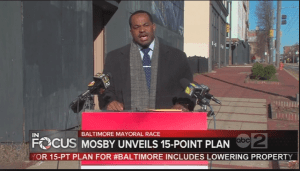 Candidate for Mayor Nick Mosby has just today published a paper called “Connecting The Dots, A 15 Point plan for Baltimore’s Future.” It’s his platform statement.
Missing The Point
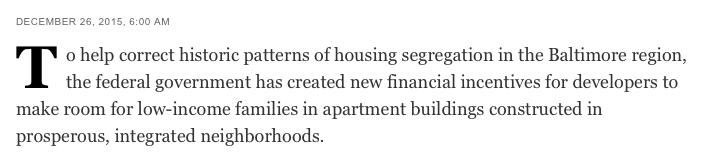 The screenshot above is the opening paragraph from a December 26, 2015 article in the Sun. It’s a good, highly informative piece by Doug Donovan.
Vacants-To-Jobs
 As you may already know, there’s a Baltimore city government program called “Vacants-To-Value.” It’s primary purpose is to encourage people to refurbish and move into vacant property around the city – properties, mostly residential, that the government has taken over. The objective is to turn the huge number of abandoned properties around the city into homes that are attractive and well-maintained by resident-owners, many of whom will be new to the neighborhood.
Eminent Domain
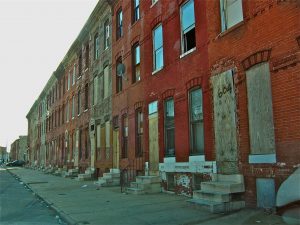 As you may have noticed, we have already posted a map of the 16,885 documented vacant structures in Baltimore. These structures – in addition to the thousands of vacant lots – are a potent tool for attracting desperately needed employers and new residents to the city.
Zoning: What’s the point?
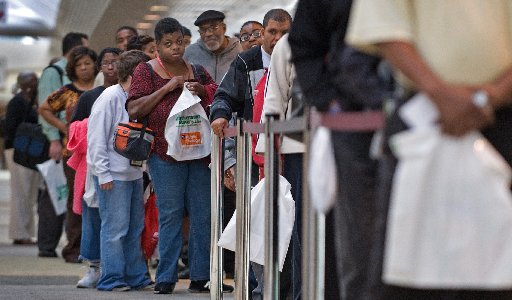
You’ll notice that the featured image for this article about zoning isn’t a map of this or that district plan. It’s people waiting in line for jobs. Whatever jobs they can get.
Technical Problem
 A few days ago, we posted an article that talked about the urgent need to study, right now, the economics of the 150,000+ complaints that are filed with “Rent Court” every year – and that result in 7000 evictions annually. It’s a really important study that addresses a very, very significant problem in our city, the resolution of which is essential to the accomplishment of the economic recovery which is our mission. (Not so subtle note to contributors… It’s a study Baltimore Rising would gladly do for the city if you’d like to fund it.)
150,000 Complaints, 7000 Evictions
 Those numbers in the title? Particularly the 150,000 in a city of only 620,000 people? They’re huge, aren’t they? They’re the number of rental unit complaints and resulting evictions that The Sun, the Washington Post, The 7000 Families Campaign and others have been talking about.