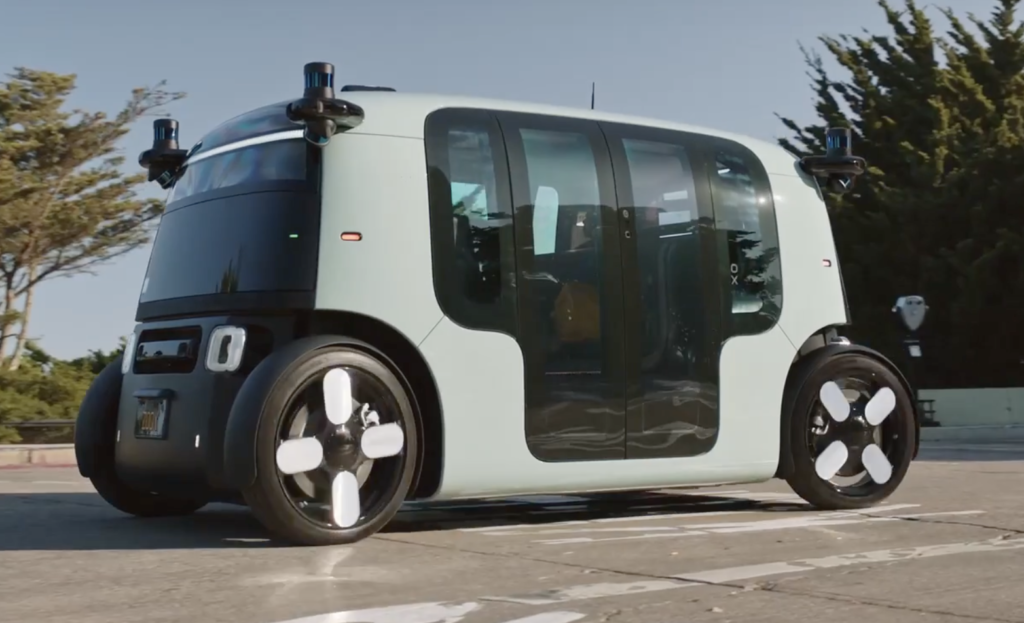
Screenshot from the Zoox.com website.
Thursday, October 1, 2026
What you’re looking at is a Zoox robotaxi. If you ask the Internet for a list of the best driverless cabs, Zoox is on the top, Google’s Waymo is in second place. The Zoox was designed to be a robotaxi from the ground up. The Waymo’s are modified Jaguars.
Front to back, the design of the Zoox is symmetrical. So which end is the front of the cab? The answer is both ends. That’s right. The Zoox has four wheel steering. It comes and goes, but is always driving forward in so far as its brain is concerned. It never needs to turn around. You know those people who, with the assistance of the backup cameras in most late model cars, prefer to back into their parking spaces in front of the grocery store or, heaven forbid, inside tightly configured parking garages? The Zoox doesn’t care. It drives into the parking space going forward and, later, out of the parking space going forward.
This thing is one marvelous, very impressive piece of automotive design and engineering. But is it the future of driverless cars for you and me? I don’t think so.
Full disclosure… I drive a Subaru Forester hybrid. It has sensors all over the place, the principal one being what Subaru calls its “Eyesight” feature which actually looks at the road in front of you, mimicking the way our eyes do it. Not withstanding all these sensors, my Forester doesn’t have an actual hands-off-the-steering-wheel driverless mode. Subaru believes in “driver-assisted” technologies and doesn’t think that full-fledged driverless operations are ready for prime time, not yet. I agree, but then what do I know?
Turns out there is an alternative coming up fast in the lane next to future driverless cars that will be the descendants of today’s robotaxis and vehicles with limited self-driving modes of operation.
“What’s that?” you ask.
Well, imagine a high-functioning humanoid robot, easy peasy by today’s rapidly evolving technologies, with an AI brain. While the most advanced and experimental driverless vehicles have as many as fifty sensors, we human drivers have only four engaged in driving – two eyes and two ears. Only four. The same number as the humanoid robot would have, in addition to certain other advantages. Like night vision, for example.
Like the computer in a driverless car, the humanoid robot is not going to be distracted by all sorts of stuff that might take our minds off the road. Not even if you engage your robot driver in conversation and why wouldn’t you? No, it’s not human, but that may not make any difference as those of us who have talked to high end AI entities can attest. Nor is it going to fall asleep at the wheel nor will it ever have one too many glasses of wine at dinner. Its reflexes will never age. In fact, the robot driver will be upgradable. Human drivers? Not so much.
So far, it’s a tie when we’re comparing the driverless car to the robot driven vehicle. But then, the humanoid robot can drive any car. Any car you might already own or buy in the future. No reason to use the driverless option sometimes, but not always, requiring that you sit behind the steering wheel and be ready to take over if necessary. …The Zoox doesn’t even have driver controls inside the vehicle.
And then there is the huge feature of function. The robot driver can get out of the car and help you in and out of it with your groceries, your children, whatever. Mow the lawn. Shovel the driveway. Do the dishes, vacuum and dust, you name it. And eventually, get back in the car and do errands for you, on its own, if that’s what you want it to do.
Relative cost? Unknown at this time, but the robot driver is such a better, more useful option, all things considered, that it will probably be worth it even if it costs more than buying a car with a truly reliable driverless system that can safely take you anywhere – one hundred percent of the time. Certainly, it’s reasonable to assume that the prices of robot drivers will tend to decline over time after the initial development costs have been fully amortized.
But then what about the social impact on our lives when ordinary people have what is, for all intents and purposes, a driver. No more pulling your car out of the garage. No more allowing time to find a parking space and walking from it and back again. No more having to spend your trip, locally or long distance, driving. Or being distracted by talking on your phone. Or sitting behind the steering wheel for that matter, presumably paying attention as if you were driving even though you’re not.
So, what will you do with all time you save when your robot driver is doing various chores for you? Will you work longer hours? Spend more time with your spouse and children? Exercise because you no longer have any excuse not to? Maybe read a book or engage in continuing education? Or all of the above?
See https://humanoidroboticstechnology.com/articles/top-12-humanoid-robots-of-2026/ for examples of what might be the predecessors of robot drivers that would be available for purchase in the next few years.
