
LinkedIn on Sunday, July 26, 2026
Tired of watching and reading about politics – and Trump in particular? I am. He’s been taking up way too much of my time. Let’s talk about something else.
In 2010, our federal government decided that it was time to include “keyboarding” in the curriculum of our public schools – in place of learning handwriting. There are only so many hours in the day. Something had to go to make room for preparing our nation’s children for the emerging technologies of our time.
Using computers became more important than learning how to write with a pencil or pen. Apparently, educators in charge of these things envisioned a time, coming fast upon us, when everyone, children included, would be communicating exclusively through digital devices and handwriting would no longer be a necessary skill. Who writes letters by hand when you can send texts and emails with AI-assisted autocorrection?
What if you can’t afford a computer, tablet or smartphone? Or find it difficult to relate to these technologies? Too bad.
By the way, if you don’t learn cursive, you can’t read cursive. So, we parents, grandparents and everyone else will have no choice but to give our cursive-illiterate kids typed or printed “to do” lists and other notes.
Can cursive-illiterate people sign their names? Are signatures about to be a thing of the past?
Not to worry. Just fifteen years later, educators have decided to put cursive back into the public school curriculum. Why’s that? Because handwriting is “an important life skill that has significant cognitive benefits” – studies indicate that writing in cursive seems to benefit learning – according to the NEA in “Why Cursive is Back in the Classroom,” published March 9, 2026.
So, what about the children who didn’t learn cursive? Will they just have to catch up on their own through Mavis Beacon and Typing.com online? …I guess so. Is it still important, even essential that they learn how to type with all their fingers? Absolutely. And the basics of using a computer? Yep, that too, but when? Do twelve year olds and even younger kids need to be computer literate or is mastering the English language, science and math more important?
My concern is that the cursive v. keyboarding debate may be distracting us from a far more important problem. So preoccupied by the dominance of digital communication, our public schools are providing our kids – as early as the third grade, but usually in middle and high school – laptops to use in school and take home with them. Mostly various brands of inexpensive Cromebooks from what I can tell.
But if educators are so concerned with the benefits of learning cursive and handwriting, why aren’t they at least as concerned about the negative effects of excessive screentime? True, access to the Internet on these laptops is limited by the school systems, to varying extents, but having that laptop still increases screentime and fosters childhood addictions to it.
Couldn’t we just put off the use of computers in public schools until high school? Even better, college? While ruling out in-school access to smartphones altogether? Maybe give kids of some minimum age cellphone watches, that they’re less likely to lose than their coveted cellphones, limited to placing calls, contacting ride sharing and, heaven forbid, parental tracking?
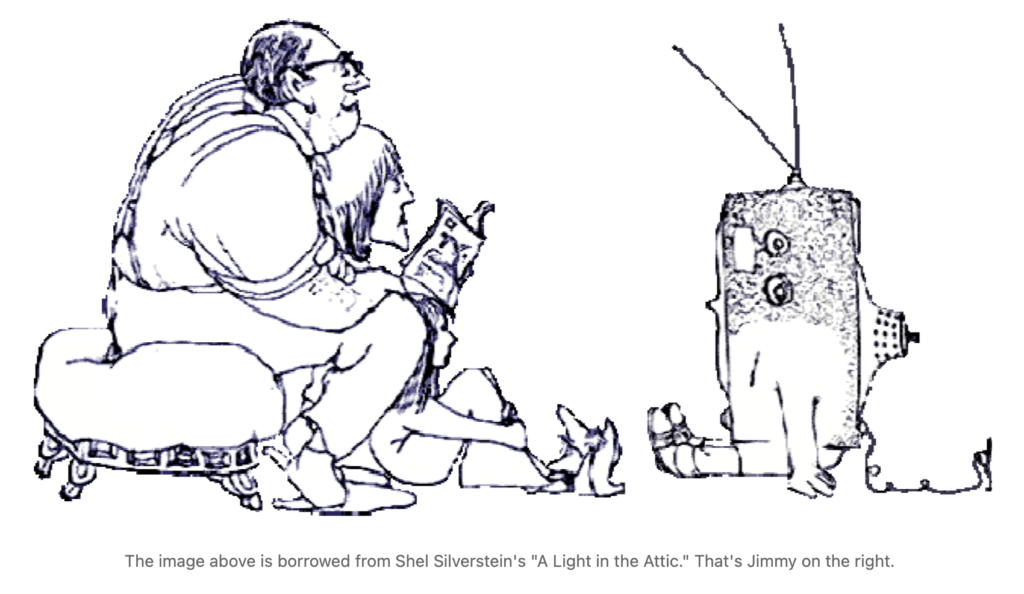
And then there’s the problem of watching television – the original screen we should have been worried about. In 1981, before the widespread use of the Internet that began in the 1990s, Shel Silverstein published “A Light in the Attic” including this poem that he entitled “Jimmy Jet and His TV Set.” (My featured image in the header is borrowed from Shel’s book.)
I’ll tell you the story of Jimmy Jet –
And you know what I tell you is true.
He loved to watch his TV set
Almost as much as you.
He watched all day, he watched all night
Till he grew pale and lean,
From “The Early Show” to “The Late Show”
And all the shows in between.
He watched till his eyes were frozen wide,
And his bottom grew into his chair.
And his chin turned into a tuning dial,
And antennae grew out of his hair.
And his brains turned into TV tubes,
And his face to a TV screen.
And two knobs saying “vert.” and “horiz.”
Grew where his ears had been.
And he grew a plug that looked like a tail
So we plugged in little Jim.
And now instead of him watching TV
We all sit around and watch him.
So, exactly how much television do you let your children watch? When they’re not on their laptops in school or doing their homework and who knows what else in their bedrooms, on their cellphones? Who among us really believes that using all these digital devices is making our kids smarter, more capable, more creative and happier?
-Les Cohen
