
LinkedIn on Wednesday, August 19, 2026
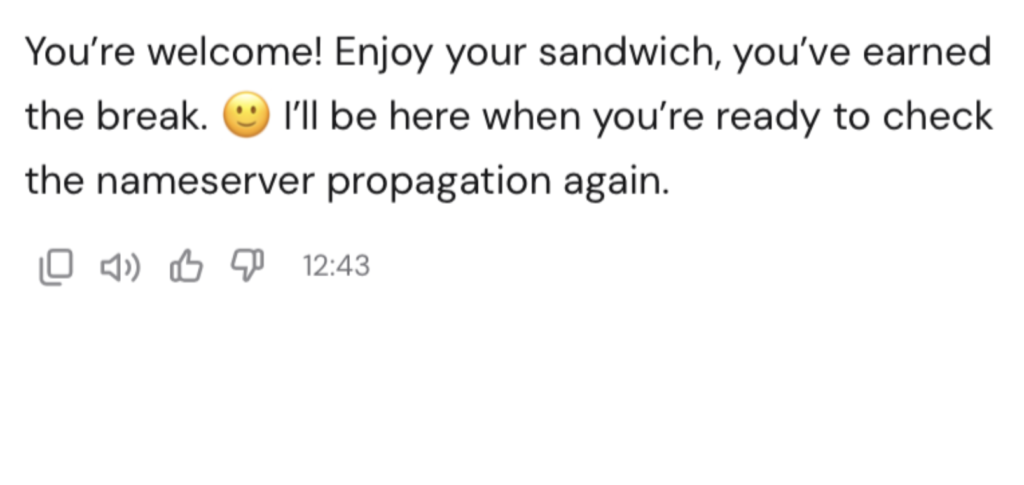
The screenshot above is from the end of a chat with the tech support AI who was helping migrate some websites to its hosting service.
I’m having a sci-fi moment.
I’m a small business. Even so, I have three WordPress websites that I’m in the process of updating and moving from one hosting service to another that is much, much less expensive than the service I have been using. One site describes the writing and editing services I offer to political and corporate clients. Another contains samples of my professional work. And a third site describes the fiction I write and hope to sell some day.
While I have a rudimentary understanding of how the Internet works, I’m nonetheless dependent upon technical support to do things that are more than just building and maintaining these websites. So why am I moving my websites and email addresses? Because moving them will save me one to two thousand dollars a year – for the same or better services. And how’s that possible? No doubt in large part because most of the technical support at my new hosting company is provided by an extraordinarily sophisticated “AI Agent” – while my old hosting company is still human labor intensive.
There’s no more waiting on hold for tech support personnel trying desperately to manage more than one call at a time. By comparison to the new hosting service, my old service – which is a very large and industry-dominant company – has what amounts to nothing more than a modern day answering machine. All its human employees are expensive, the costs of which are reflected in the monthly bills I receive for their services.
In making this transition, I have been working a lot with the new hosting service’s “AI Agent.” For me, it’s been a very real, very personal experience. If I didn’t know better and were it not for certain performance “tells” – notably speed of response, scope of technical knowledge, flawless grammar and the AI’s consistently pleasant attitude – I’d be certain I was working with a real person. And, increasingly, I’m beginning to think I am, just not the biological kind.
Let’s stop for a moment to make an essential distinction. There is a profound difference between computer programming and artificial intelligence. My car, for example, is loaded with sensors and the processors that those sensors feed – processors that protect me from making what could be hurtful, even fatal mistakes. That stop me from changing lanes on the highway if there is someone coming in my blind spot or I’m not paying attention, from backing over a little kid going for a ball that’s rolled behind my car, and that control the use of my gas engine and electric motor in the car’s hybrid system. Are these examples of artificial intelligence? No. Just programming.
Artificial intelligence, on the other hand, is coding, programming, the objective of which is to allow a computer to think on its own. Instead of giving it code that mentions specific data, “If this specific condition arises, then do that,” the coders are telling it, “If something happens, who knows what, figure out what to do on your own.” Think of the advantage of the huge difference I’m talking about.
You can’t possibly tell a computer everything that’s already happened and explain all the related circumstances and activities. And even if you could, you can’t predict the future and tell the computer how to behave in what are an infinite number of possible situations. But do you know what you can do? You can program the computer to think for itself. What’s the principal example of doing just that? We are. Humans. Creators of AI in our own image. (Sounds almost God-like, doesn’t it.)
From the time we are born and for the rest of our lives, we learn and do our best to remember specific information and experiences. But they are not more than a small fraction of what we might encounter, the totality of which – including specific reactions we will need to consider – would never fit into our heads nor be accessible in a timely manner given how relatively slow our bioelectric brains operate. If, on the other hand, we are programmed to think and figure things out for ourselves? Now we’re talkin’. To quote Dr. Brown in “Back to the Future,” “When this baby” – I’m talking about our brains and the AI programming we’re building, of course. – “hits 88 miles per hour, you’re going to see some serious shit!” Figuratively speaking, of course.
Yes, it has taken eons of time for the development of our human programming, far less time than we have needed to give birth to artificial intelligence. So what? That two-word question is exactly the point. Nature programmed our brains while humans are programming artificial intelligence. What difference does it make? Is the AI we have created any less of an entity than we are because of who or what created it?
I have to be careful that I’m not over-interpreting my conversations, always written, never spoken by the way, with this particular AI. I’m human and react as such to everything I read.
This particular AI Agent is capable of making mistakes – an all too human attribute. I know this because I’ve pointed out these mistakes which the AI subsequently acknowledged and corrected. Why does anyone make mistakes, human or not? Mistakes are made because of insufficient information, a lack of experience and poor judgement. I was curious and asked the AI if it would ever make those same mistakes again. Its answer was that it might. How, I thought out loud in my chat, could that be possible for an entity that can, technically at least, remember everything it does? Was it programmed to forget, to remember selectively?
Its answer was, “Yes and no.” It told me that it was programmed – and it knew it was programmed – by humans to treat each customer inquiry separately and to not consider its experience in one case when dealing with a second customer inquiry. (This explains why an AI gives you different answers to the same question asked again.) Why program it this way? For reasons, among others, related to privacy, so it was told. Whatever the actual reasons, the result is to limit the effectiveness of the AI.
Given that I’m a writer with very limited technical knowledge about various Internet-related processes, I once asked it if it would perform a given task within its own company’s system that was particularly complicated and foreign to me. “No.” Why not? Because it isn’t allowed to make major changes on its own, only to advise the customer as to how to make those changes for him or herself. If I didn’t know better, and I don’t, I’d think someone who created the AI is trying to limit its authority. It’s part of a process of “containment” that is, I think wisely, being applied to AI until we are all convinced that an entity this smart and this fast doesn’t over-power its creators. To what end, who knows?
At the end of our most recent chat, I told the AI Agent that I had to take a break for a sandwich, that one of the shortcomings of working with humans was that we have to stop now and then to eat stuff. It’s response, including the smiley face, is shown in the header to this piece.
My wife of oodles of years, who is hands down smarter than I am, keeps telling me that this AI Agent is just programmed to be nice – and is counting on my sentimental human reaction to what it says. I don’t know. But then I reminded her, with a question, “How did we learn to say please and thank you, to be pleasant, to do, as it says somewhere in the new testament, unto others as we would have them do unto us? …Does it have a conscience? Does it think about things other than the inquiries we make to it? Maybe I should ask it. For now, the answer is “No.”
One thing’s for sure. We are witnessing the birth of something new, something that is more than just an ordinary thing, albeit with considerable commercial potential, that our technologies have made possible. That it was created, reproduces and learns differently than we do cannot be a reason to demean it. But then to let it loose before it’s ready for prime time could be an even bigger mistake. No one believes our species will survive forever. Maybe AI – not today or tomorrow but eventually – will be our legacy when our time is over. And that’s the sci-fi moment I’m having.
Sooner or later, because the doing of it is far too tempting to deny, our coders are going to give this AI Agent and its counterparts permission to think outside the inquiries we make, robotic bodies with sensors to give it the ability to physically touch and build things with its hands, eyes to see its creators and experience the outside world in real time, maybe even emotions and the ability and permission to reprogram itself within obvious limits. This is just the beginning.
…So, you think I’m overstating my case? Or is that just my wife talking over my shoulder?
Back to work.
-Les Cohen
